Using stepladders correctly
Learn how to use stepladders safely in the workplace. This article offers a comprehensive guide on best practices, maintenance and inspection to prevent accidents, in accordance with Portuguese safety guidelines.
· 5 minutos · Segurança no Trabalho
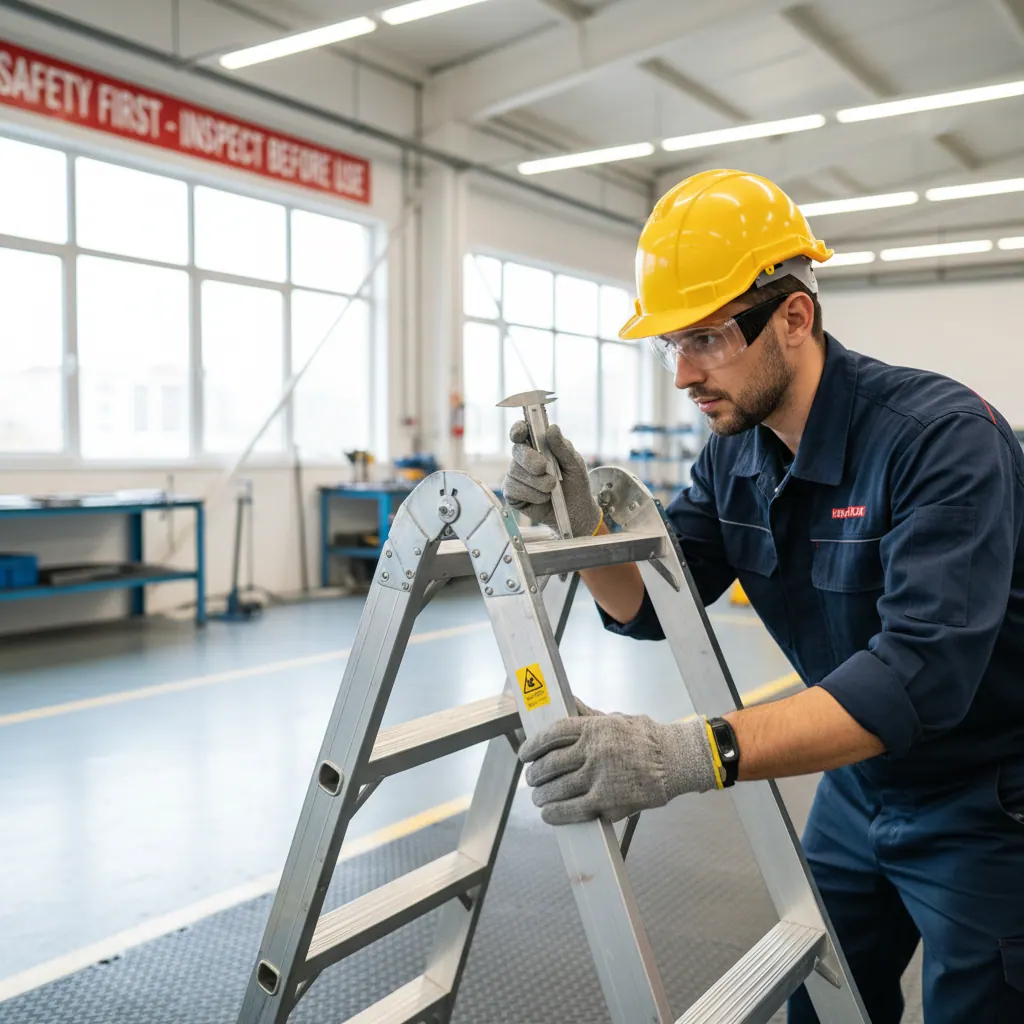
The stepladder is a common work tool in many sectors and professional contexts. However, its incorrect use can lead to serious accidents. With the aim of promoting a safer working environment, we highlight the essential guidelines for its proper handling. Do not neglect your safety and prevent accidents that are entirely avoidable.
Pre-use inspection and maintenance
Before each use, it is fundamental to carry out a thorough visual inspection of the stepladder. Check the following points:
- General condition: Ensure there is no visible damage, such as cracks, warping or corrosion.
- Rungs and stiles: Rungs must be clean, dry and firmly fixed. Stiles must not show any deformations or cracks.
- Safety devices: Check the proper functioning of locks, hinges and other locking mechanisms. If the ladder is extension-type, ensure that the brackets function correctly.
- Feet and pads: Anti-slip feet and pads must be intact, clean and without excessive wear, to guarantee good grip on the ground.
- Labels and markings: Confirm that safety and load capacity labels are legible and present. Always respect the indicated maximum load.
Any detected anomaly must lead to the immediate withdrawal from service of the ladder. Never use a damaged ladder.
Safe positioning of the ladder
The correct positioning of the ladder is crucial to prevent falls. Follow these guidelines:
- Stable surface: Place the ladder on a flat, firm and non-slip surface. Avoid uneven, soft or slippery ground.
- Proper angle: The ideal slope for leaning ladders is approximately 75 degrees. A good rule of thumb is that the base of the ladder should be away from the wall by about a quarter of its working length.
- Extension above the support: When leaning the ladder against a structure, it must extend at least one metre above the support point, facilitating access and egress.
- Securing or tying: Whenever possible, the ladder should be tied or secured to prevent slipping or unexpected movement.
- Prohibition of positioning in doorways or passageways: Never position a ladder in front of doors that may open suddenly or in transit areas without proper signage and isolation.
Correct and safe use
When climbing, descending or working on a stepladder, adopt the following practices:
- Three points of contact: Always maintain three points of contact with the ladder (two hands and one foot, or one foot and two hands) to ensure stability.
- Climb and descend facing the ladder: Always climb and descend facing the ladder.
- Do not carry excessive loads: Distribute weight evenly and avoid carrying objects that could unbalance you or prevent you from holding the ladder.
- Do not overreach: Keep your belt buckle within the limits of the ladder stiles. If you cannot reach, climb down, move the ladder and climb up again.
- Do not use the top rungs: Stepladders must not be used on their top rungs (the top three rungs on leaning ladders and the top two rungs on stepladders), unless they have a work platform and handrail.
- Single-person use: Stepladders are designed for use by only one person at a time.
Relevant legislation in Portugal
In Portugal, the use of work equipment, including stepladders, is regulated by specific legislation aimed at ensuring occupational health and safety. Decreto-Lei n.º 50/2005, of 25 February, transposing Directive 2001/45/EC into national law, establishes the minimum safety and health requirements for the use of work equipment.
It is fundamental that companies ensure their workers receive adequate training, as required by Article 131 of the Portuguese Labour Code approved by Lei n.º 7/2009, of 12 February, in its current wording, which establishes the obligation of continuous training, ensuring the development of employees' qualifications and preventing risks.
Conclusion
The safe use of the stepladder is a shared responsibility involving both the employer, in providing suitable equipment and training, and the worker, in complying with established safety rules. Following these guidelines not only prevents accidents but also contributes to a more productive and safer working environment. Remember: safety is always the priority.