Drills: Reinforcing Knowledge in Occupational Safety and Health
Drills for occupational safety and health in Portugal. Learn to plan and execute exercises to strengthen emergency preparedness.
· 7 minutos · Segurança no Trabalho
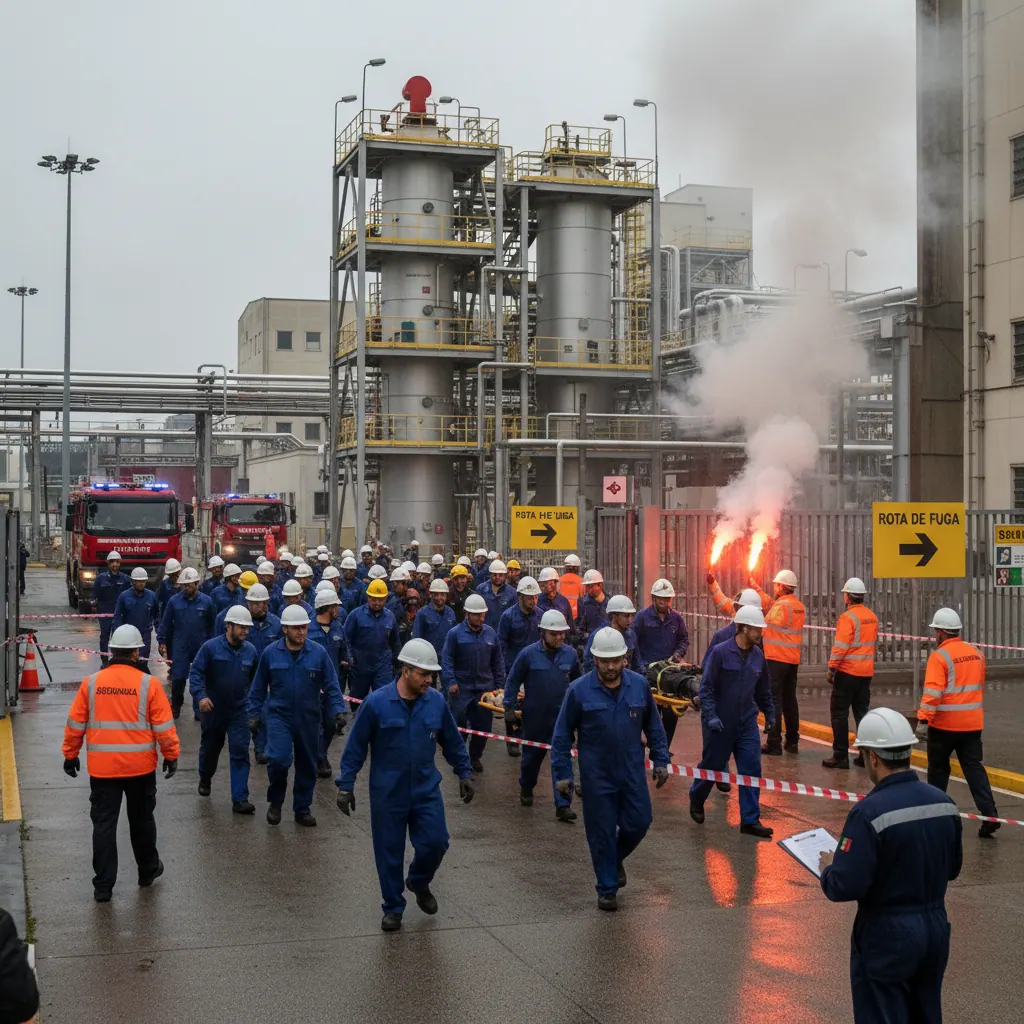
It is common for us to encounter news reports, through the media, of accidents (fires, explosions, chemical leaks) in industries or buildings, resulting in victims and extensive material and environmental damage. Situations whose scale and impact can hardly leave us indifferent.
Prevention and facility maintenance are essential to avoid an emergency. However, if one materializes, it is crucial to act immediately to ensure the safety of affected people, control the situation, limit its extent, and prevent greater damage.
Although we hope never to experience such a situation in the company, it is essential to be prepared. All companies must anticipate potential emergencies arising from their activity or external factors and be able to face them with their own means. To this end, they must develop Emergency Measures or a Self-Protection Plan, which constitute the set of actions and measures designed to provide an adequate response to these situations.
To verify the adequacy and effectiveness of these emergency plans and measures, the best approach is to carry out drills.
Objectives of a Drill
Drills aim at several crucial objectives in emergency management:
- Evaluate the effectiveness of the emergency response organization;
- Train personnel assigned to the response organization;
- Train all company personnel;
- Verify the sufficiency and adequacy of allocated means and resources;
- Adjust operating procedures.
Tasks Prior to Carrying Out the Drill
Before carrying out a drill, it is essential to train the personnel who are part of the emergency control teams and to inform all employees about the measures to be adopted. Once this stage is completed, it is possible to organize a drill to check whether the measures and actions unfold in practice as planned.
The execution of a drill requires prior and detailed planning of the emergency scenario to be recreated. A preparatory meeting between those responsible is advisable to define the type of emergency to be simulated, dates, time, affected location or zone, people and teams involved, among other aspects.
Depending on the existing risks and the type of emergencies, drills can vary in complexity and involve the mobilization of different personnel, with evacuation being convenient to include. The possibility of having observers external to the intervention tasks, properly identified and distributed at strategic points, should also be considered, to verify the development of actions and detect failures and opportunities for improvement.
Information Management
When carrying out a drill, it's time to put into practice what has been learned. The first time a drill is carried out in a company, it is recommended to notify all personnel in advance about the day, time, and conditions of its execution, in order to avoid panic and discomfort, which can arise if someone confuses it with a real emergency.
In subsequent drills, it is also convenient to remind or reinforce the information on operating procedures and specific training for all participants. It is important that drills are carried out periodically so that personnel acquire habits and gradually assimilate behavior patterns.
According to the level of training and previous experiences, the information provided to workers can be progressively restricted, hiding the time, then the day of the week, until a calm, organized, and effective response to an emergency situation is achieved.
It is also possible to progressively increase the complexity of situations, incorporating elements that, although uncommon, may arise during an emergency and hinder actions (blockage of usual evacuation exit, failures in alert or communication systems, trapped people, absence of team members, injured people, etc.). The drill should be periodic, but it should not become a monotonous and routine activity. With creativity and imagination, it can become a challenge for the organization.
For establishments with high risk, either due to the activity developed or the characteristics of the location, it may be advisable to invite external aid (active or as observers). This way, it is possible to verify the coordination of actions and allow them to know the facilities firsthand, evaluating the difficulties in case of intervention. In any situation, it is crucial to notify emergency services and the police in advance about the drills, to avoid the mobilization of resources resulting from alerts from third parties who may observe an anomalous situation.
Analyze to Improve
After the drill is completed, it is essential to evaluate the exercise and draw conclusions, mainly related to response times, actions, procedures, use of protective equipment, coordination, communications, incidents, among others. The results of this analysis and its conclusions must be recorded in a report, which will also include the corrective or preventive measures to be implemented.
Detecting flaws in the drill or imperfections in its operation should not be considered a failure. On the contrary, it is the identification of these flaws that allows for the continuous improvement of the adopted measures and procedures and, above all, constitutes valuable training and learning. After all, what is truly learned is what is experienced in practice.