Health Damage from Exposure to Mechanical Vibrations
Explore the health damage caused by exposure to mechanical vibrations, including exposure limits and associated pathologies. Protect your health at work.
· 8 minutos · Segurança no Trabalho
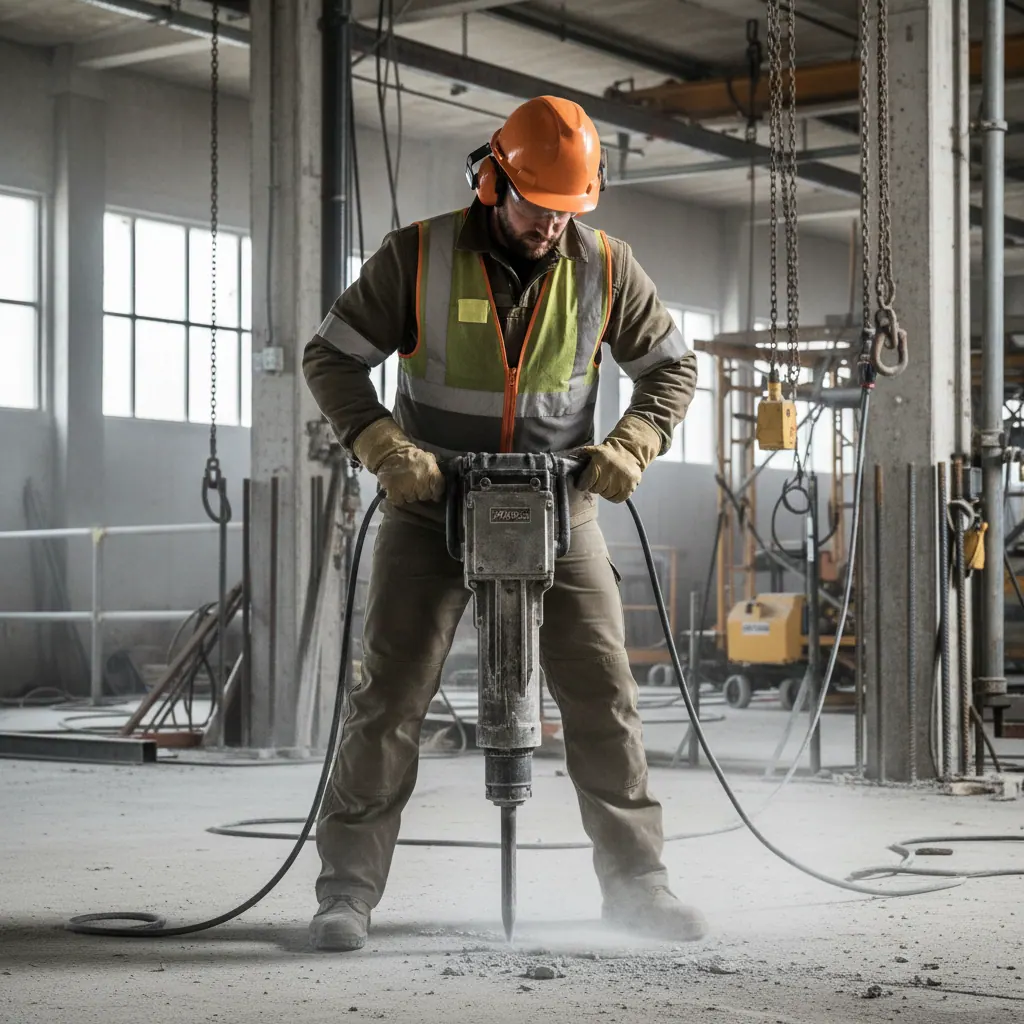
Mechanical vibrations pose a significant risk to worker health and safety. These can penetrate the body through the upper extremities (hand-arm) or the entire body (whole-body), resulting in various pathologies.
What Are Mechanical Vibrations?
Vibration is said to occur when there is an oscillatory motion of an elastic mechanical system relative to a reference position. It is the movement of a solid body around its equilibrium position without net displacement of the vibrating object.
The vibration frequency, expressed in hertz (Hz), is a critical factor, as it affects the extent of vibration transmission to the body. We can differentiate two main types of vibrations, depending on their frequency and mode of transmission:
High-Frequency Vibrations (Hand-Arm) (20 - 1000 Hz)
These are transmitted to the human hand-arm system, posing health and safety risks, particularly vascular, bone, joint, nerve, or muscle problems. They tend to be damped, and their propagation is limited to the contact area with the emitting source, mainly affecting the upper extremities. They are common in the handling of vibrating mechanical tools.
Low-Frequency Vibrations (Whole-Body)
These are transmitted to the entire body and carry health risks, such as low back pain and spinal injuries. They are not easily damped, and their effects can manifest in various parts of the body, far from the point of contact. This includes vibrations of:
- Low frequency (1-80 Hz): associated with vehicles, vibrating platforms.
- Very low frequency (<1 Hz): such as the swaying of vessels.
Exposure Limit Values
To protect workers' health, daily exposure limit values have been established:
- Hand-Arm System:
- Daily exposure limit value (8h): 5 m/s².
- Daily action value: 2.5 m/s².
- Whole-Body:
- Daily exposure limit value (8h): 1.15 m/s².
- Daily action value: 0.5 m/s².
Population at Risk
Workers continuously exposed to mechanical vibrations exceeding the established action levels are considered at risk. Risk assessment is fundamental to determining the existence and intensity of exposure.
Among the activities that can cause osteoarticular or angioneurotic diseases due to exposure to mechanical vibrations, the following stand out:
- Vascular affections (Vibration-induced Raynaud's Syndrome): Work with machines or objects that transmit vibrations to the hand and arm (frequency from 25 to 250 Hz), such as pneumatic hammers, percussion drills, polishers, grinders, mechanical saws, brushcutters, riveting tools, and sealing guns. Also, work involving the repeated support of the heel of the hand percussing a fixed and rigid surface.
- Osteoarticular changes: The same exposures as vascular affections.
- Diseases due to whole-body vibrations: Mainly linked to driving vehicles and machines or platforms subject to vibration, often causing discopathies in the thoracolumbar spine due to repetitive vertical vibrations.
Health Effects
Health effects are divided according to the type of vibration:
Hand-Arm Transmitted Vibrations (High Frequency)
- Osteoarticular: Elbow osteoarthritis, acromioclavicular or scapulohumeral osteoarthritis, avascular necrosis of the lunate (Kienböck's disease), avascular necrosis of the scaphoid (Preiser's disease), and others. Although rare in the shoulder, osteoarthritis of the acromioclavicular joint is frequent, followed by the humero-scapular joint. Hand-arm vibrations primarily affect the wrist, with Kienböck's disease being a notable example, with different variants of manifestation.
- Musculoskeletal: Pain, stiffness, contractures, decreased muscle strength, tendinitis, and weakness.
- Vascular (Angioneurotic Syndrome): Raynaud's phenomenon, known as white finger disease, characterized by episodes of vascular spasm causing pallor, numbness, and decreased sensitivity in the fingers (except the thumb). It usually occurs in two phases: ischemia (pale and cold fingers) and reactive hyperemia (pulsating pain, tingling, swelling, and increased temperature).
- Neuromuscular: Sensory peripheral neuropathy, with possible perineural edema, pain, numbness, decreased strength, and sensitivity. Carpal Tunnel Syndrome, tendinitis, bursitis, and Dupuytren's contracture may arise.
Risk factors such as temperature, airflow, humidity, noise, and individual conditions (diabetes, smoking) can worsen vascular pathologies.
Whole-Body Transmitted Vibrations (Low and Very Low Frequency)
- Discomfort: Reduced work capacity due to acute fatigue.
- Motion sickness (Transport sickness): Especially on vessels, with symptoms such as pallor, cold sweats, nausea, and vomiting, in acute exposures between 0.8 and 2 Hz (or 0.12 and 0.3 Hz on ships).
- Spinal changes: Low back pain, disc changes (hernia, extrusion, disc degeneration), and neuropathies. The intensity and duration of exposure increase the risk.
- Optical: Vestibular changes (very low-frequency vibrations).
- Visual: Changes in visual acuity and field, optical illusions, and nystagmus (involuntary eye movement).
Other damages (gastrointestinal, renal, circulatory, female reproductive) are reported but with less scientific evidence.
Health Surveillance
Given the potential health damage, the employer must ensure the health surveillance of workers whenever the risk assessment reveals the existence of risk. This surveillance is necessary in situations such as:
- Continuous exposure to levels exceeding the action levels (2.5 m/s² for hand-arm or 0.5 m/s² for whole-body).
- Occasional exposures that, due to their frequency and intensity, pose a risk.
- Manifestation of vibration effects or if the worker is particularly sensitive due to personal conditions (traumas with vascular sequelae, discopathies) or concomitant exposures (cold, humidity, exertion) that may enhance the effects.
- Activities mentioned in legislation on occupational diseases, if the risk assessment indicates a risk.
This measure is crucial for the prevention and early detection of health problems, ensuring a safer work environment in accordance with occupational safety and health guidelines.