How to change workers' perception of occupational risks
Discover how to change workers' perception of occupational risks and promote safer behaviors through training and awareness. Detailed article on occupational safety and health.
· 6 minutos · Segurança no Trabalho
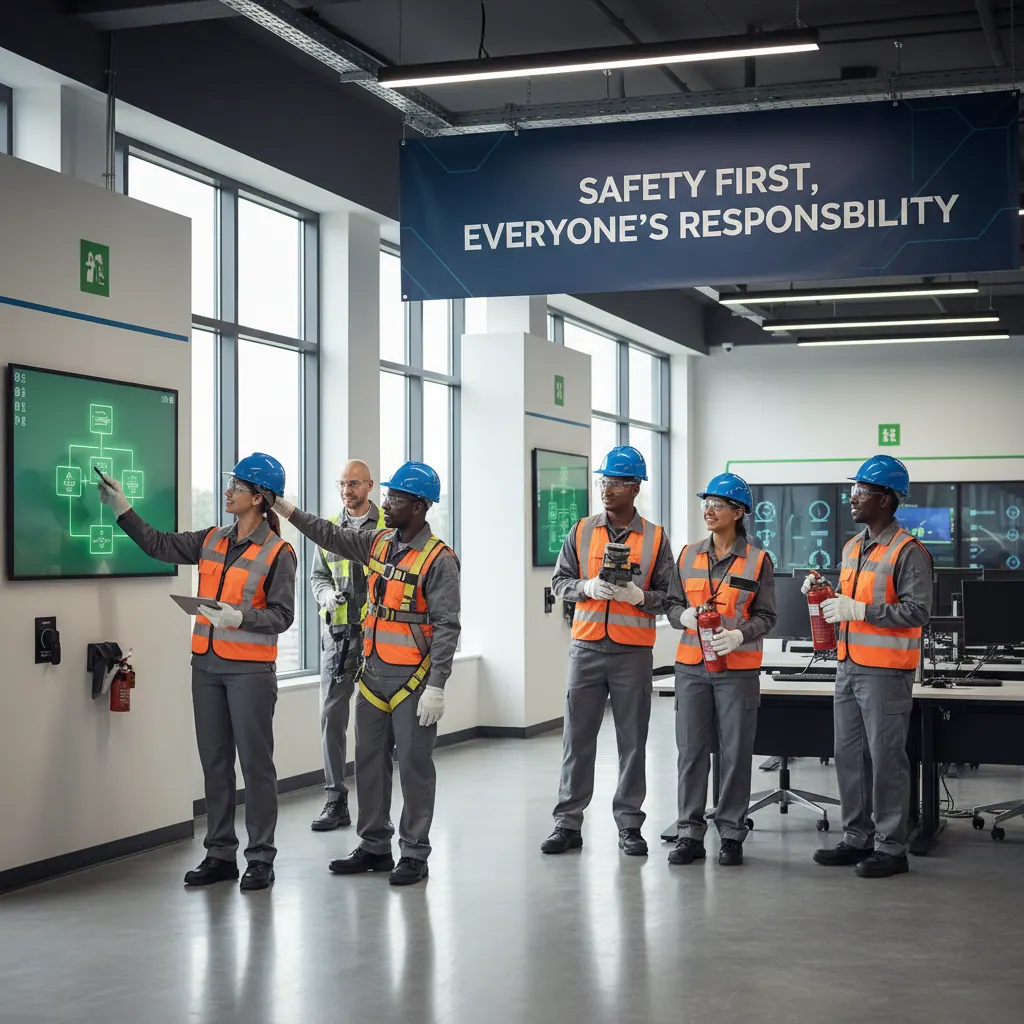
Worker awareness is the essential basis for consolidating workplace safety in companies.
For organizations to continue progressing in Occupational Safety and Health, it is crucial to consider the "Human Factor" as a key element to achieve greater commitment in this area.
Although it is important to provide workers with rules, procedures, technical controls, and safe workplaces, it is equally vital to motivate, convince, and train them to change their values and attitudes towards Safety and Health.
To this end, we must establish two main objectives:
- Make workers aware of the consequences of taking risks at work and the importance of complying with/following established rules and procedures.
- Succeed in modifying the individual's unsafe attitude and, consequently, produce a change in behavior/conduct.
A relevant tool for achieving these purposes are training courses based on Behavioral Safety. These training courses give a prominent role to the learning of identification and emotional self-management skills, behavior modification techniques, self-awareness, relationship skills, and risk perception skills.
Organizations observe the need to address the change in risky behaviors through methods specialized in human behavior, different from those used until now. Changing the attitude of the people who make up the organization regarding workplace safety is essential to reduce accidents and incidents, as established in Lei n.º 102/2009, de 10 de setembro (Law no. 102/2009, of September 10), which establishes the legal framework for the promotion of occupational safety and health.
Conditions for Safe Behavior
The behavior-based safety model is based on the Triconditional Theory of Safe Behavior (Meliá, 2007), which advocates the existence of three conditions for a person to work safely: they must be ABLE to work safely; they must KNOW how to work safely; and they must WANT to work safely.
These three conditions are an indispensable requirement for safe behaviors to manifest, and depend on technical and human factors. This model allows, in addition to assessing risks, intervening in them based on the factors of each group that are failing.
- KNOW refers to the knowledge (theoretical and practical) that a person must have about how to perform their job safely. The "KNOW HOW".
- ABLE refers to the aptitudes, both physical and mental, that a person must possess, and the conditions of the work environment, to perform their activity safely. The "CAN DO".
- WANT refers to attitudes. Motivation, desire, and willingness to perform the job safely. The "WANT TO DO".
What is necessary for employees to work safely?
We need a more holistic vision to achieve change in organizational safety. For this, it is fundamental to consider the whole. The parts cannot be seen independently, but rather together, interconnected and oriented towards a common goal: SAFETY.
These three conditions are necessary, and none is, by itself, sufficient. It is enough for one of the three to fail for the person not to be able to perform a job safely.
Workers are, in practice, those who can lead and value safe behaviors at work, setting an example, together with middle management and leaders.
Each worker is a behavior model, and it is therefore necessary to instill, promote, practice and reward safe behaviors in the organization.
To lead and achieve safer behaviors from workers, the involvement of management, hierarchical line, prevention area and related departments is essential.
The goal is for workers, the hierarchical line, management, and prevention to be true agents of behavioral change. Thus, we are all an indispensable link in Safety and Health in the company.