Specific training for safety and health at work in wind farms
Safety and health at work in the wind sector are crucial. Learn about GWO training, its modules (working at height, first aid, etc.) and the applicable legislation in Portugal to ensure a safe and certified working environment.
· 6 minutos · Segurança no Trabalho
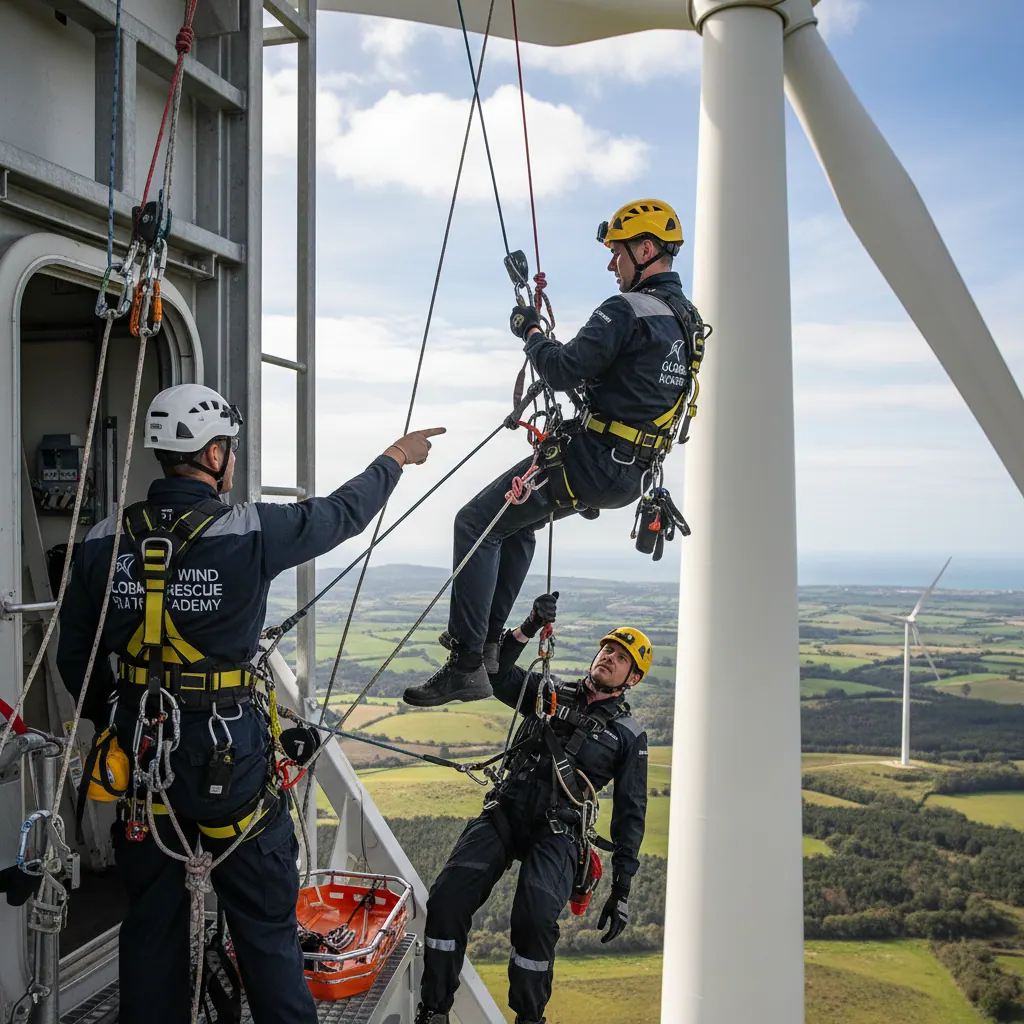
The Global Wind Organization (GWO) is a non-profit organisation founded by leading wind turbine manufacturers and operators. Its objective is to promote a safer and more productive workforce through certified training, essential for the global wind industry.
The Rise of the Wind Sector and the Need for Training
The wind sector is expanding rapidly, representing an area of significant growth and the creation of new employment opportunities. With this growth, it is imperative that workers are properly prepared for the inherent challenges and risks of these operations, especially in complex environments such as wind farms.
Why GWO Certification?
GWO certification is mandatory for subcontractors and workers in the wind sector. It ensures the provision of services in an optimised and safe manner, being a requirement to access contracts with the main players in the wind industry. The Global Wind Organization (GWO) integrates the largest companies in the sector worldwide, which have developed rigorous training programs to ensure the safety and health of employees.
These programs cover areas such as:
- First Aid
- Manual Handling
- Fire Awareness
- Working at Height
- Sea Survival (for offshore operations)
GWO defines the safety content necessary for work in the wind energy sector, developing the didactic material for professionals to certify themselves in the required specialties.
BST (Basic Safety Training Standard) Training Modules
The BST (Basic Safety Training Standard) training modules are structured to cover essential safety competencies:
- BST – Working at Height: 805 minutes of training.
- BST – First Aid: 420 minutes of training.
- BST – Manual Handling: 215 minutes of training.
- BST – Fire Awareness: 200 minutes of training.
Training Modalities
GWO training is divided into two main modalities:
- ONSHORE: Includes the four BST modules mentioned above, intended for workers in onshore wind farms.
- OFFSHORE: In addition to the four BST modules, it includes an additional Sea Survival module, designed for professionals operating in the offshore wind industry. This module aims to provide participants with knowledge and skills to act safely and implement preventive measures in all maritime activities, from land to installation and vice versa, covering normal and emergency situations in an offshore wind turbine environment.
Training Validity and Recertification
BST training is valid for 24 months. After this period, it is essential to undergo recertification training, designated as BSTR (Basic Safety Training Refresh), to renew the certification for another 24 months. The BSTR modules are similar to the initial ones, but with adapted durations:
- BSTR – Working at Height: 420 minutes of training.
- BSTR – First Aid: 240 minutes of training.
- BSTR – Manual Handling: 215 minutes of training.
- BSTR – Fire Awareness: 200 minutes of training.
To access the BSTR modules, the trainee must meet two requirements:
- Have previously completed the corresponding GWO BST modules.
- Not more than 24 months must have passed since the initial training or the last recertification.
Other Additional Modules
Recently, a module was integrated into GWO focused on the use of lifts in wind turbines, lasting 4 hours. Its objectives are to ensure the safety of workers and to standardise the design and operation of lifts in the industry. The validity of this training is permanent, although recertification every 24 months is recommended.
There is also the ART (Advanced Rescue Training) module, which deepens the control of risks associated with rescue operations of victims in complex environments (blade, hub, nacelle, among others). This module ensures a more efficient operation and the self-sufficiency of rescuers. ART is composed of four courses:
- ART-HSIBR: Hub, Spinner and Inside Blade Rescue.
- ART-NTBR: Nacelle, Tower and Basement Rescue.
- SR:HSIBR: Single Rescuer: Hub, Spinner and Inside Blade Rescue.
- SR:NTBR: Single Rescuer: Nacelle, Tower and Basement Rescue.
The only requirement to attend these courses is to have valid basic GWO training in Working at Height, Electrical Risk (equivalent or integrated into the other modules, such as First Aid with an electrical risk component), Manual Handling and First Aid.
It is essential to remember that GWO training can only be provided by certified entities, thus guaranteeing the quality and recognition of professional qualification in the wind sector. Always look for accredited institutions for initial training, refresher training, or advanced modules.