Exposure to Carcinogenic Agents: Diesel Engine Emissions as an Occupational Risk
Discover the classification of diesel engine emissions as carcinogens, the Portuguese legal framework, and essential measures to protect workers from exposure to this occupational risk.
· 6 minutos · Segurança no Trabalho
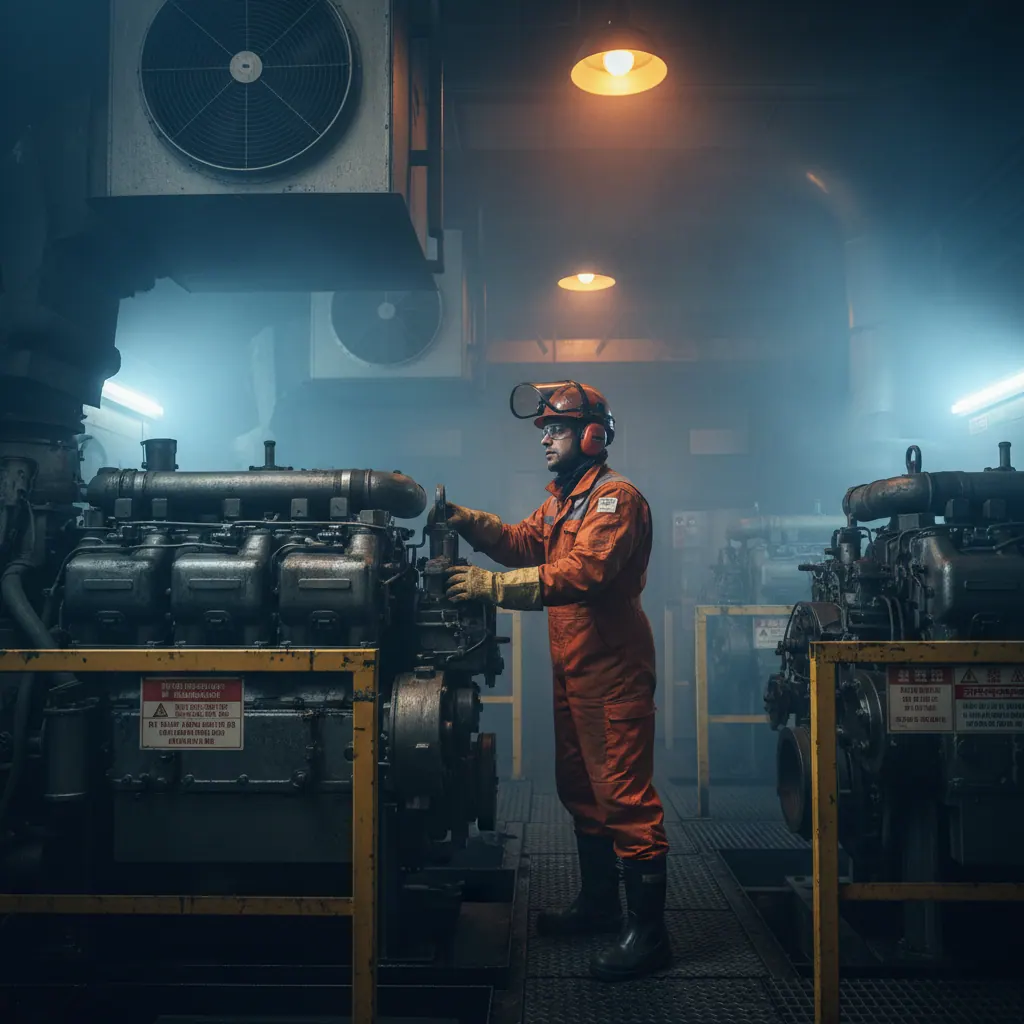
In recent years, there has been increasing recognition of the health risks associated with exposure to carcinogenic agents in the workplace. Diesel engine emissions, in particular, have been subject to attention due to their classification as a human carcinogen by the International Agency for Research on Cancer (IARC).
This article addresses the legal framework and the implications of this classification for workplace safety and health in Portugal, as well as the preventive measures that should be adopted.
Legal Framework and Classification
The Directorate-General for Health (DGS) and the Authority for Working Conditions (ACT) in Portugal play a crucial role in overseeing and promoting compliance with worker protection standards. The classification of diesel engine emissions as carcinogenic is supported by international bodies and European directives that Portugal transposes into its legislation.
The International Agency for Research on Cancer (IARC), part of the World Health Organization, classifies carcinogenic agents as follows:
- Group 1: Carcinogenic to humans.
- Group 2A: Probably carcinogenic to humans.
- Group 2B: Possibly carcinogenic to humans.
- Group 3: Not classifiable as carcinogenic to humans.
Since 2014, the IARC classifies diesel engine exhaust fumes as carcinogenic to humans (Group 1). This classification is based on robust scientific evidence linking exposure to these emissions to an increased risk of lung cancer.
This international classification, along with opinions from European scientific committees, motivated the inclusion of diesel engine emissions in Directive (EU) 2019/130, which amended Directive 2004/37/EC on the protection of workers from the risks related to exposure to carcinogens or mutagens at work. This European directive is transposed into Portuguese law through specific diplomas, namely the legislation regulating the protection of workers from the risks of exposure to chemical, physical, and biological agents at work.
What are Diesel Engine Emissions?
Diesel engine emissions are a complex mixture of combustion gases and tiny carbon particles. They are produced during the combustion of diesel in engine cylinders.
- Combustion gases account for about 40% of total emissions. They include carbon dioxide (CO2), carbon monoxide (CO), nitrogen dioxide (NO2), nitrogen monoxide (NO), and sulfur dioxide (SO2), as well as nitrogen (N2), water vapor (H2O), and oxygen (O2).
- Carbon particles, also known as soot, come from diesel and engine lubricant, making up more than 60% of total emissions. These particles have organic compounds adhered to their surface, such as aldehydes and Polycyclic Aromatic Hydrocarbons (PAH), metal oxides, and sulfur derivatives. A professional exposure limit value is established for these carbon particles.
It is essential to emphasize that, with current scientific knowledge, limit values for carcinogenic agents do not mean a threshold below which there is no risk to workers' health. On the contrary, they represent a value associated with an increased probability of developing cancer – a stochastic effect – for certain concentrations of the agent in the worker's breathing zone. In industrial hygiene, these values are used as maximum references for adopting preventive measures, and lower values do not eliminate the risk.
Occupational Exposure and Preventive Measures
Identifying occupational exposure to diesel emissions is the first step. This applies to any workplace where the release of these emissions is expected, especially in enclosed environments.
Preventive measures must follow the hierarchy of risk control, as established in the Portuguese Labor Code (Código do Trabalho) and specific workplace safety and health legislation:
Substitution: The most effective measure is the substitution of diesel engines with alternatives that have fewer or no emissions. For example, the use of gasoline engines or, preferably, electric motors, which completely eliminate emissions.
Engineering Controls: If substitution is not feasible, the possibility of working with the carcinogen in a closed circuit should be considered. Although complex for diesel emissions, this may involve localized exhaust systems directly on the exhausts or aspiration hoods.
Reduction to the Lowest Possible Level: When the previous measures are not sufficient, it is imperative to reduce the level of exposure to the lowest technically possible value. This requires a combination of preventive measures:
- Local extraction: Application of aspiration systems directly connected to vehicle or equipment exhausts.
- Artificial general ventilation: Increasing the air exchange rate in the work environment to dilute pollutant concentrations.
- Natural ventilation: Where applicable and effective, through opening doors and windows.
- Organizational measures: Task rotation, limitation of exposure time, and optimization of work schedules.
- Cleaning and hygiene: Rigorous maintenance of workstations, equipment, and vehicles.
- Work clothing: Appropriate and regularly washed to prevent the accumulation of contaminants.
- Personal Protective Equipment (PPE): Use of appropriate PPE, such as respiratory masks with suitable filters, when other measures do not guarantee sufficient protection.
- Training and information: Workers must receive detailed training on the risks of diesel emissions, the preventive measures to adopt, and the correct use of PPE.
- Health Surveillance: Periodic medical examinations to monitor the health of exposed workers and detect any health impacts early.
The implementation of these measures is crucial to protect workers' health and ensure a safe working environment, in accordance with national and European guidelines.